30 Most Common Interview Questions in 2026 (With Winning Answers)
The complete playbook to Nigerian interviews in 2026, including sample answers, sector patterns, and the frameworks that separate candidates who get offers from candidates who get ghosted.

To answer the 30 most common interview questions in 2026, use the STAR method (Situation, Task, Action, Result) for behavioural questions and definitive value-based answers for questions about your background, strengths, and goals. Nigerian employers from GTBank to Flutterwave score candidates on clarity, specificity, and cultural fit. Every answer needs a concrete example, a quantified result, and a clear link to the role.
How to Use This Interview Questions Guide
This guide covers all 30 questions with Nigeria-specific sample answers, sector patterns for banking, tech, oil and gas, FMCG, and consulting, and the framework shifts that matter in 2026. The article is organised into seven question categories: background, strengths and self-assessment, behavioural and experience questions, career goals, situational and problem-solving, fit and 2026-specific questions, and closing questions. Each question includes a note on what the interviewer is scoring.
One step separates candidates who improvise from candidates who perform consistently: building a Story Bank before the interview. A Story Bank is a curated library of ten to twelve of your experiences organised by competency theme so you can retrieve the right story quickly instead of freezing. The concept is introduced in Careergrill's Why You Keep Getting Rejected After Interviews, which gives you the full extraction methods and scoring rubric for building one in seven days.
The 6 Dimensions Nigerian Interviewers Score You On in 2026
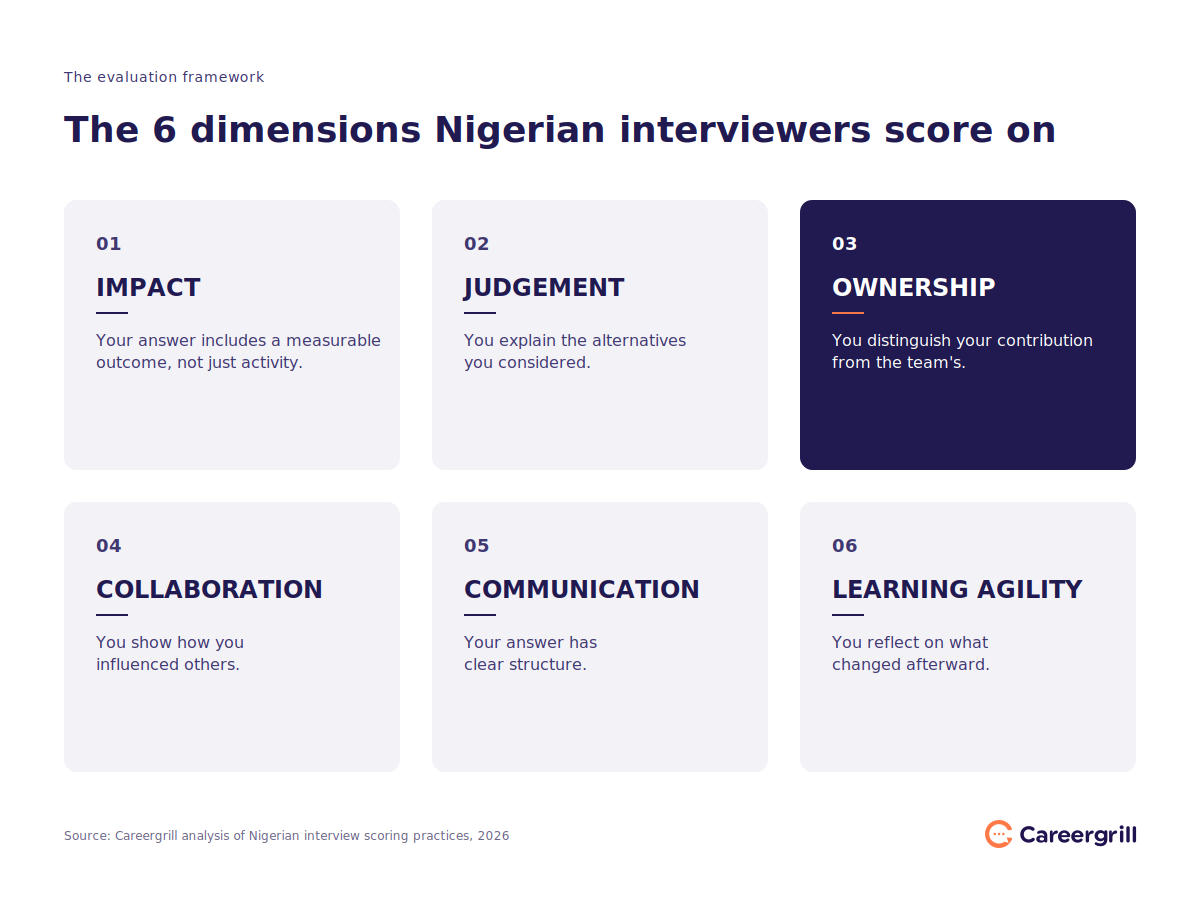
Structured behavioural interviews score candidates on six evaluation dimensions: Impact, Judgement, Ownership, Collaboration, Communication, and Learning Agility. Every question in this article maps to one or more of these, and strong candidates demonstrate evidence across all six over a full interview. Each dimension shows up differently. Impact means your answer includes a measurable outcome, not just a description of activity. Judgement means you explain the alternatives you considered. Ownership means you clearly distinguish your contribution from the team's, which is critical in Nigerian workplaces where collective framing ("we") comes naturally. Collaboration means you show how you influenced others. Communication is scored on the structure of your answer itself. Learning Agility means you reflect on what changed afterward. Ninety-two percent of talent professionals now say soft skills are as important or more important than hard skills in 2026, according to LinkedIn research.
What Is the STAR Method and How Do You Upgrade It for 2026?
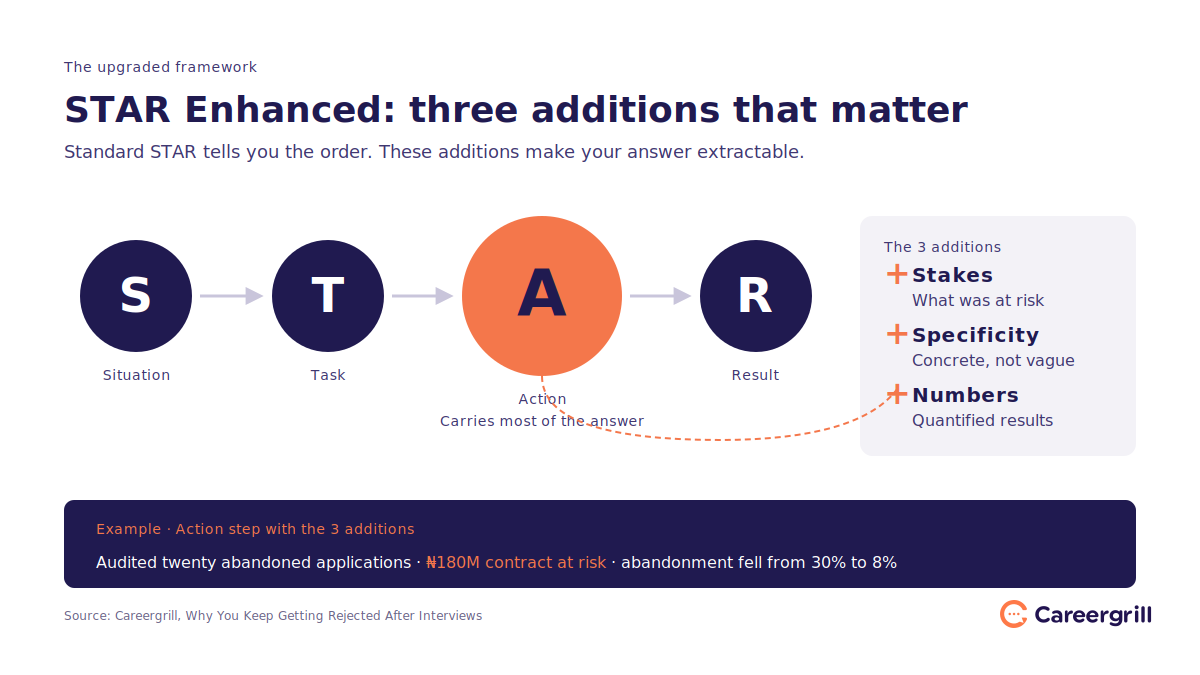
STAR stands for Situation, Task, Action, Result, the most widely used framework for answering behavioural interview questions globally. Most candidates know it. Very few use it well. Standard STAR tells you the order to present information but not what makes an answer compelling.
Careergrill's Why You Keep Getting Rejected After Interviews introduces an upgraded version calledSTAR Enhanced, which adds three elements most candidates miss: Stakes (what was at risk if the problem wasn't solved), Specificity (concrete actions rather than vague "I coordinated with the team" phrasing), and Numbers (quantified results). A story without stakes has no tension; an answer without numbers reads as opinion rather than evidence. The Action step carries the majority of your answer because that is where the interviewer does most of their scoring.
This evidence-first approach matters more in 2026 than ever. Salma Rashad, Global Executive Vice President of Talent Acquisition at Siemens, has observed that AI-powered assessment tools now help interviewers go beyond resumes and conventional conversations to predict candidate success. Candidates who structure their answers as extractable evidence score measurably higher than those who talk around their experience.
Here is STAR Enhanced applied to a Nigerian workplace example:
"During my NYSC year at a microfinance bank in Ibadan, monthly customer onboarding had dropped 30% because the documentation process required four in-person branch visits, and rural customers were abandoning after the second. The branch manager asked me to review the process. I audited twenty abandoned applications, found three of the four visits were for signature collection that could be consolidated, and proposed a single-visit model with pre-filled forms sent ahead by SMS. I piloted with fifteen customers in two weeks. Abandonment dropped from 30% to 8%, onboarding time fell from three weeks to five days, and the model was rolled out to three other branches."
STAR Enhanced is one of six question-type frameworks in the book. The others include Decision Stories, Conflict/Influence, Values Stories, Failure Stories, and Micro-Stories for rapid screens.
Category 1: Questions About You and Your Background
1. "Tell Me About Yourself"
The single most asked interview question globally and in Nigeria. It opens nearly every first-round interview, from GTBank's Executive Trainee panels to Flutterwave's recruiter screens. Use a three-part structure: Present (your current role in one sentence), Past (one or two relevant experiences that led here), and Future (why this role is your next step). Keep it to 60–90 seconds, roughly 150–200 words.
Sample answer:
"I'm currently a Business Analyst at Access Bank, where I've spent two years on the retail lending portfolio. Before Access, I completed my NYSC at a Lagos consulting firm, supporting a state government digitisation project. That's where my interest in fintech started. I'm applying to Flutterwave because I want to move from analysing banking products to building the payment infrastructure defining African fintech's next decade. My background in lending risk maps directly to your compliance and merchant onboarding challenges."
One sentence on present, two on past with concrete employers, one on why this role. No filler about being "passionate" or "hardworking."
2. "Why Should We Hire You?"
This is your elevator pitch. Three parts: skill match + proof point + value you'll add to this specific team. The mistake most Nigerian candidates make is listing generic qualities ("I'm a team player, hardworking, detail-oriented") without evidence. Replace every adjective with an example.
Sample answer:
"You should hire me because I combine the quantitative discipline the role requires with real customer-facing experience most fresh graduates don't have. In my final year at university, I led a research project on SME lending in Kano and interviewed thirty-two business owners about their banking pain points. That work taught me to listen before I recommend. For a graduate trainee rotation that will put me in front of SME customers within six months, that experience translates directly."
3. "Walk Me Through Your CV"
Different from "Tell me about yourself." This version is chronological and detail-focused: the interviewer is holding your CV and checking that you can narrate transitions, not just list jobs. Spend most of your time on the two or three most relevant roles.
Handle career gaps honestly. For NYSC, name the employer and the one or two things you learned that apply to the role. For role changes, explain the decision briefly without badmouthing previous employers. With a strong CV, you should have three versions ready depending on how much time the interviewer signals: 30-second highlight reel, 60-second standard version, 90-second detailed narration.
4. "What Do You Know About Our Company?"
This is the research test. Most candidates fail it by reciting generic facts from the homepage. Strong candidates prepare four categories: recent news (a product launch, partnership, or leadership change from the last six months), stated values, the company's footprint, and competitive positioning (who they compete with and on what basis).
Sample answer for an interview at MTN Nigeria:
"MTN is Nigeria's largest telecoms operator with over 80 million subscribers, but the work that interests me is the push into fintech through MoMo Payment Service Bank. Since its 2022 launch, MoMo has signalled that MTN is positioning against the traditional bank-led mobile money model. I've also followed the Ayoba super-app expansion and the recent focus on enterprise connectivity for Nigerian SMEs. For a product marketing role, I'd want to understand how you're differentiating MoMo from OPay and PalmPay. That's the conversation I'd love to have today."
A strong answer names a specific product, cites an actual market dynamic, and ends with a question that invites the interviewer to continue.
5. "Why Do You Want This Job?"
Avoid three answers Nigerian recruiters hear daily: "I want to grow my career," "I want to work with a great team," "I've always been passionate about [industry]." The strong version connects a specific responsibility in the job description to a specific part of your trajectory.
Sample answer:
"The role spec mentioned owning merchant onboarding as the first major workstream. That's exactly the problem I spent eighteen months on at my current employer, where we cut onboarding time for SME merchants from eleven days to four. I want this role because it's a chance to apply what I learned at a much bigger scale, and because your international expansion means solving the same problem across five different regulatory environments."
6. "Why Are You Leaving Your Current Job?"
Handle diplomatically. Never badmouth your current or previous employer, even if you have legitimate grievances. Nigerian interviewers, especially in banking and consulting, treat negative framing as a red flag. Three acceptable framings: growth, scope, alignment.
Sample answer:
"I've been at my current company three years and I'm grateful for what I've learned. I came in managing a small operations team and now own a full regional portfolio. What's missing is the chance to work on payment products at scale, which is the next direction for my career. My current employer is a traditional FMCG, and the product innovation pace is different from what I'm looking for. This role is a cleaner fit for where I want to specialise."
Category 2: Strengths, Weaknesses, and Self-Assessment
7. "What Are Your Greatest Strengths?"
Pick two or three strengths genuinely relevant to the role, and back each with a specific example. Avoid clichés ("hardworking," "team player," "fast learner") unless you can prove them with evidence. BusinessDay Nigeria's 2026 skills analysis, identified communication, critical thinking, collaboration, and adaptability as the four soft skills Nigerian employers prioritise most heavily this year.
Sample answer for a consulting analyst role:
"My two strongest skills are structured communication and analytical precision. At my last role in a Lagos research firm, I presented findings to C-level clients weekly. I developed a habit of leading every deck with a single-slide answer, followed by three supporting arguments. This is the opposite of how most analysts present. On the analytical side, I built the financial model for a ₦2.3 billion acquisition screening that went on to be the firm's template for subsequent deals."
8. "What Is Your Biggest Weakness?"
The most-feared interview question, and the most-botched. The rule: pick a real weakness, show self-awareness, and describe what you're actively doing to improve it. Avoid the "I work too hard" and "I'm a perfectionist" clichés; interviewers are trained to flag these as evasions. This question maps to the Learning Agility dimension introduced earlier: interviewers are scoring whether you reflect on what changed in your approach, not whether the weakness itself is impressive.
Sample answer:
"My biggest weakness is that I used to avoid delegating. In my first supervisory role, I kept doing execution work my junior colleagues should have handled, because I was faster and I didn't want to slow things down. The cost was real. My team wasn't developing, and I was consistently working until 9 PM. Six months ago I started a deliberate practice: every week I identify two tasks I'd normally do myself and assign them to a team member with a short briefing. The output is 80% of what I'd produce, but the team's overall capacity has roughly doubled. I'm still working on it."
9. "How Would Your Colleagues or Manager Describe You?"
A triangulation question: the interviewer wants to know if your self-description matches how others see you. Use two or three adjectives with brief justification, and reference actual feedback you've received.
Sample answer:
"My manager's last performance review described me as 'unusually steady under pressure.' Direct quote. Colleagues tend to describe me as the person they come to when a project is stuck. Part of that is because I ask a lot of clarifying questions before committing to a plan, which slows me down at the start but tends to prevent rework later. The one trade-off is that people sometimes read my early questioning as scepticism, so I've worked on signalling engagement earlier in conversations."
10. "What Are You Bad at?" (The Direct Variant)
Some Nigerian interviewers, especially in banking, oil and gas, and Big Four consulting, ask this more bluntly than the softer "weakness" question. A stammering or evasive response is the fastest way to tank it.
Sample answer:
"That's a direct question, so I'll give you a direct answer. I'm bad at unstructured networking events. I'm fine in one-on-one meetings and formal presentations, but the cocktail-hour circuit genuinely drains me. It matters for a client-facing role, so I've been addressing it by setting specific targets (three conversations before I leave, one follow-up message the next day) rather than trying to reinvent my personality."
Category 3: Behavioural and Experience Questions
11. "Tell Me About a Time You Faced a Major Challenge at Work"
The most common STAR Enhanced opportunity. Pick a story with real stakes and quantify the result. Nigerian candidates often describe team achievements using "we" throughout, which blurs their contribution and scores low on Ownership. The fix is a simple "we-to-I" reframe: acknowledge the team, then zoom in on your specific role without feeling dishonest.
Sample answer:
"At my previous employer, a logistics company handling FMCG distribution across the South-West, our main warehouse vendor missed three consecutive weekly deliveries, putting a ₦180 million client contract at risk. I audited the vendor's performance and found they were mid-relocation and couldn't recover. Within four days I sourced two alternative vendors, negotiated expedited pickup terms, and managed a parallel transition with zero delivery gaps. We retained the client, cut logistics costs 14% because the new vendors were cheaper, and I built a quarterly vendor health-check process that didn't previously exist."
That answer hits every dimension: Impact, Judgement, Ownership, Communication, and Learning Agility.
12. "Describe a Time You Worked Successfully as Part of a Team"
The failure mode is passive team descriptions like "we all worked together and it was great" that say nothing about what you did. Describe your specific contribution using "I" while acknowledging the team. Research cited by The Interview Guys in late 2025 found 89% of professionals consider cross-team collaboration important or very important to job satisfaction.
Sample answer:
"I was part of a five-person task force rolling out a new customer loyalty programme across our retail network. My role was stakeholder coordination. The programme needed sign-off from marketing, operations, IT, and legal, and a previous attempt had stalled because those teams weren't aligned. I ran weekly 30-minute check-ins with one representative from each team, kept a shared tracker of blockers, and made sure no team waited more than 48 hours for a decision. The programme launched in eleven weeks against an original estimate of sixteen and is now live in 240 retail outlets."
13. "Tell Me About a Time You Showed Leadership"
Leadership is not the same as a job title. Without management experience, cite project leadership, NYSC leadership, or informal leadership: the moment you stepped up when nobody formally asked you to. What matters is that you drove an outcome through other people. The bar shifts with seniority. Early-career candidates can reference NYSC or student leadership; senior candidates need organisational-scope stories. Pick an example calibrated to the role.
Sample answer:
"During my NYSC year, I was posted to a rural secondary school in Benue that had a computer lab's worth of donated equipment sitting unused because no teacher had been trained. I wasn't asked to fix it, but I saw the opportunity. I organised three other corps members with relevant skills and agreed on a six-week plan. I handled logistics: getting permission, sourcing furniture locally, and persuading the principal to allocate two hours a week of timetable space. We set up fourteen working computers, trained six teachers, and ran a basic ICT curriculum for 90 students before our service year ended."
14. "Describe a Time You Had a Conflict with a Colleague. How Did You Handle It?"
Never say "I've never had conflict at work." Interviewers read this as either dishonesty or a signal you avoid difficult conversations. The strongest answers use a Conflict/Influence structure: identify the stakeholders, name the tension, describe your approach, narrate the actual conversations (not just the outcome), and close with the resolution. The conversation is where the interviewer scores your collaboration and communication skills, not the outcome alone.
Sample answer:
"My team lead and I disagreed sharply about the launch plan for a new customer-facing product. He wanted simultaneous release across all three regions for market impact. I believed we should pilot in Lagos first, because our call centre was at 82% utilisation and couldn't handle simultaneous issues. Rather than escalate, I asked for a thirty-minute meeting, presented the utilisation data, and proposed a phased launch starting with Lagos. I acknowledged his approach would create more initial visibility and offered an additional marketing push to compensate. He agreed. We launched in Lagos without a single SLA breach, and by the time we went to Port Harcourt, we'd already fixed two issues we couldn't have handled at full volume."
15. "Tell Me About a Time You Failed"
Another feared question. The rule: pick a genuine failure where you were meaningfully responsible, where consequences were real but not catastrophic, and where you can clearly articulate what you learned. Lying ("I've never really failed") is worse than the failure itself.
Careergrill'sWhy You Keep Getting Rejected After Interviews includes a dedicated Failure Story framework for this question. The book's key insight: the strongest failure answers don't just show a personal lesson learned. They show what you changed systemically so the failure couldn't recur.
Sample answer:
"Early in my role as a project coordinator, I was responsible for delivering a client training rollout by end of Q2. I accepted a verbal timeline estimate without stress-testing it or building any buffer. We missed the deadline by three weeks. The root cause was entirely on me. I informed the client immediately, renegotiated the timeline, and prioritised the three modules with the most immediate value. Afterwards I introduced a planning protocol on every project: written estimates from every dependency, a 20% time buffer, and a mid-project checkpoint where we explicitly ask what could derail the remaining timeline. I haven't missed a delivery date in eighteen months."
16. "Give an Example of a Time You Went Above and Beyond"
Distinguish genuine discretionary effort from "doing your job well." You need a specific story where you identified something that wasn't your responsibility, chose to take it on, and delivered a concrete outcome.
Sample answer:
"As a customer success associate at a SaaS company, I noticed our SME renewal rate was 68% while enterprise clients renewed at 94%. SMEs were officially owned by a different team, but I pulled six months of support ticket data and realised SME clients were asking the same five questions repeatedly and never reaching product value. I built a self-serve onboarding guide over two weekends, tested it with four SME clients, iterated based on feedback, and handed it to the SME team. Within a quarter, SME renewal rose to 79%. I wasn't asked to do it and I wasn't credited publicly, but it was the right thing for the business."
17. "Tell Me About a Time You Dealt with a Difficult Customer or Client"
Especially relevant for banking, telecoms, FMCG, and any role that puts you in front of external stakeholders. Teach the de-escalation narrative: specific situation, what the customer actually needed, how you listened, how you resolved it, and the quantified outcome.
Sample answer:
"At Access Bank, a high-net-worth customer walked into the branch furious because a ₦4 million transfer had been reversed with no explanation. He was threatening to close his account. I asked him to sit down and walked through the reversal with him on my screen. Compliance had flagged the recipient's account, and the automated system had acted before the relationship manager could reach him. I acknowledged the communication failure, called the compliance officer while he was sitting there, and got the clearance in under twenty minutes. I also committed to a direct call from his RM within 24 hours for any future compliance hold. He didn't close the account, and six months later he referred two other customers."
Category 4: Career Goals and Motivation
18. "Where Do You See Yourself in 5 Years?"
This question tests ambition versus flight risk. Framework: role growth, skill development, contribution to the company. Avoid "CEO" (reads as arrogance) and "I don't know" (reads as drift). The question maps to the Judgement dimension: interviewers score how well your stated trajectory aligns with what they can realistically offer. Answer "I want to be in a C-suite role in five years" for a role with a seven-year promotion path and you've told them you'll leave.
Sample answer:
"In five years, I'd expect to be leading a team of four to six analysts in the same domain, owning a full product or portfolio rather than working within one. I want to deepen my expertise in regulatory-grade analytics, the specialisation I've started to build. Beyond the technical side, I'd want to be mentoring the next generation of analysts. This role is attractive partly because the team structure gives that trajectory a clear path."
19. "What Motivates You?"
Keep it work-related. Problems to solve, impact on users, skill development, collaborative environments: all acceptable. Even if you're honestly motivated primarily by compensation, do not make money the headline motivator. Most Nigerian hiring managers read "money" as the primary driver as a signal you'll leave for any higher offer.
Sample answer:
"What motivates me is the moment when a messy, complicated problem resolves into a clear answer, especially when that answer changes something for a real user. The most energising period of my last two years was when I led the merchant onboarding redesign. Every week I watched the drop-off numbers improve, and I knew there were actual Nigerian SMEs on the other end now able to accept payments. That feedback loop is what keeps me in the work."
If the interviewer follows up with "anything else?", do not repeat yourself. Add a second motivator that reveals something different about you (mentorship, technical depth, working with cross-functional teams) and briefly link it to a specific experience.
20. "What Are Your Long-Term Career Goals?"
Similar to the 5-year question but broader. Tie goals to the employer's trajectory where possible. The World Economic Forum's Future of Jobs Report 2025 projects that 39% of required skill sets will have shifted by 2030, so employers are listening for candidates who can articulate a path of continuous learning rather than a fixed endpoint.
Sample answer:
"Long-term, I want to own the strategy function for a Nigerian fintech at the scale you're building toward. That means mastering three things over the next decade: regulatory navigation across multiple African markets, product economics at scale, and building teams that can execute under uncertainty. I don't see those as separate skills. They compound. This role puts me at the intersection of all three from year one."
21. "Why Did You Choose This Career Path?"
Especially common for career switchers and recent graduates. Tell the story of the pivot or the origin. Nigeria has seen a significant wave of career switchers in the last three years, with the federal government's 3MTT programme targeting three million tech talents by 2027 and a noticeable flow from banking into tech.
Sample answer for a banking-to-tech switcher:
"I spent four years at Stanbic IBTC in relationship management. The work was good training. I learned credit, customer segmentation, and how to have uncomfortable commercial conversations. What pulled me into tech was realising that every improvement I was recommending to my SME clients depended on digital infrastructure that didn't exist yet. I started learning SQL at weekends, then enrolled in a six-month data analytics programme. For the last eighteen months I've been a data analyst at a B2B fintech. The banking background is an asset (I read financial statements the way a tech analyst reads logs) but tech is where I want to build the next decade."
Category 5: Situational and Problem-Solving Questions
22. "How Do You Handle Stress and Pressure?"
Do not say "I work well under pressure" without proof; that's the answer interviewers hear from everyone. Describe a specific technique and a past example. The World Economic Forum's 2025 analysis identified resilience and flexibility among the fastest-rising core skills in demand.
Sample answer:
"Under pressure, I break the problem into the smallest possible next action and focus on that one thing. Last year our team was three days from a major client presentation when the analyst who owned the financial model resigned unexpectedly. I had roughly 40 hours to rebuild from scratch while managing two other deliverables. I listed every section of the model, estimated time for each, cut two non-essential sections, and sequenced the rest by dependency. I delivered on time, and the client signed the next phase of work. Breaking problems into the smallest next action replaces panic with a concrete step."
23. "How Do You Prioritise Your Work When You Have Multiple Deadlines?"
Name an actual framework (the Eisenhower Matrix, impact-versus-effort scoring, or a personal system) and describe how you apply it with a concrete example. Banking, consulting, and Big Four roles specifically probe for structured prioritisation because these environments routinely require juggling three to five parallel workstreams.
Sample answer:
"I use a version of the impact-versus-effort model I built during my time at a consulting firm. Every Monday, I list everything on my desk and score each item on two dimensions: consequence if late, and effort required. High-consequence, low-effort items get done first. High-consequence, high-effort items get blocked out in focused time slots, usually mornings. Low-consequence items either get delegated or scheduled later in the week. I review on Wednesday afternoon and re-sort if priorities have shifted. It's stopped me from the old pattern of treating whatever was shouting loudest as the most important."
24. "What Would You Do If You Disagreed with Your Manager?"
This question carries particular weight in Nigerian corporate environments, where directly challenging a senior colleague can feel culturally uncomfortable. Most candidates either over-commit to deference ("I would defer, they have more experience") or over-commit to confrontation. Both answers lose points.
The strongest approach for candidates in high power-distance cultures: demonstrate assertiveness and respect simultaneously. Acknowledge the senior person's position, state the issue grounded in data, propose a specific alternative, and land on a collaborative outcome.
Sample answer:
"I'd first make sure I actually understood my manager's reasoning. Often what looks like disagreement is missing context on one side. If we still disagreed, I'd ask for a one-on-one rather than raising it in a group setting. I'd acknowledge their experience and the factors they were weighing, then present the data I was looking at and propose a specific alternative. In my current role I've had three substantive disagreements with my manager over eighteen months. Two went my way after the conversation, one went his way after I understood factors I hadn't seen. The process was the same in both directions: respectful, data-grounded, proposal-based."
Category 6: Fit, Culture, and 2026-Specific Questions
25. "Which Recent Technology or Tool Have You Adopted That Improved Your Workflow?"
This is the defining 2026 interview question. The World Economic Forum's Future of Jobs Report 2025 found that two-thirds of employers plan to hire talent with specific AI skills, while 85% plan to upskill their existing workforce. Nigerian firms, especially Flutterwave, Paystack, Andela, KPMG, and PwC, now routinely ask this in first-round screens.
Answer authentically. Name the tool, describe the workflow improvement, and link it to how you'd apply the same thinking in the role. The failure mode is naming ChatGPT or Copilot without a specific use case, which reads as trend-following.
Sample answer:
"About a year ago I built a Claude-based workflow for synthesising customer interview notes. Before that, I was spending roughly six hours a week manually extracting themes from 8–12 sales call transcripts. I built a prompt chain that extracts verbatim quotes organised by theme, tags each with the customer segment, and flags any quotes that contradict our current positioning. The workflow cut that task from six hours to about 45 minutes, and it caught three recurring objections we hadn't been tracking. The principle (use AI for structured extraction so human time goes to interpretation) is what I'd bring to any customer-facing analytics role here."
26. "How Do You Work in a Hybrid or Remote Team?"
Hybrid work has reshaped Nigerian corporate hiring over the last three years. A 2024 Zoho survey of 500+ Nigerian organisations found that 55% of Nigerian businesses still operate fully onsite, 31% have adopted hybrid models, and 14% function entirely remotely. Tech firms, consulting partnerships, and Lagos-based companies with distributed teams weigh this question heavily.
Sample answer:
"I've worked in a fully hybrid team for the last two years: three days in the office, two remote. Three habits make it work. First, I write more than I used to. Decisions that would previously happen in corridor conversations now go into shared documents with context. Second, I default to async for anything not urgent. Third, I over-communicate progress; my team lead knows where I am on every deliverable without having to ask. Those habits make hybrid feel less like two separate jobs and more like one coherent workflow."
Category 7: Closing Questions
27. "What Are Your Salary Expectations?"
The highest-stakes closing question. Nigerian salary research requires specific sources: Jobberman's annual salary guide, Glassdoor Nigeria, MySalaryScale, and LinkedIn Salary. Give a range, not a point number. Express flexibility without undercutting yourself.
Current 2026 benchmarks: Executive Trainee positions at tier-1 banks range from ₦245,000 to ₦541,000 net monthly. Standard Chartered and Stanbic IBTC sit near the top at ₦511,000–₦514,000, with GTBank and Access slightly below (GTBank raised salaries by 40% in September 2024 to offset inflation). Mid-level software engineers at Flutterwave, Paystack, and Moniepoint command ₦900,000 to ₦1.8 million monthly, with senior engineers clearing ₦2 million plus equity. FMCG and consulting graduate trainee programmes start at ₦350,000–₦600,000 monthly.
Careergrill'sWhy You Keep Getting Rejected After Interviews introduces the Credibility Code, a system for presenting numbers that hold up under scrutiny. The headline principle: a defensible range beats a single figure that collapses under challenge.
Sample answer for a mid-level analyst role in Lagos:
"Based on Jobberman and LinkedIn Salary data for comparable roles in Lagos, the range is roughly ₦850,000 to ₦1.3 million monthly, with the top end applying to candidates with specific domain expertise. Given my three years of experience and credit analytics specialisation, I'd target ₦1.1 to ₦1.3 million as a base, with flexibility based on the overall package."
Caution: do not quote USD ranges for Nigeria-based roles unless the role is explicitly dollar-denominated.
28. "When Can You Start?"
Brief but important. Standard acceptable answers: two weeks if you're currently employed on a standard contract, immediately if you're between roles, and the Passing-Out Parade date if you're currently an NYSC corps member.
Under the Nigerian Labour Act, the statutory minimum notice period is one day for contracts under three months, one week for three months to two years, two weeks for two to five years, and one month for contracts of five years or more. However, private-sector contracts often specify longer notice. One to three months is standard for mid-career roles, and senior positions can require three to six months. Read your contract before you give a date.
Sample answer:
"My current contract specifies one month's notice. If I accept an offer, I'd submit my resignation the same day, which puts my earliest start at about five weeks from offer acceptance: four weeks of notice plus a week to close out handover properly."
29. "Do You Have Any Questions for Us?"
Never say "No, I'm fine." This response is a direct hit to the Communication dimension. It signals weak preparation and low interest, regardless of how well the rest of the interview went. Walk in with at least five prepared questions and adapt based on how the interview unfolded.
Five questions you can always ask:
- Curiosity about the business: "What's the most interesting challenge the team has solved in the last six months?"
- Strategic thinking: "Where do you see this role evolving in the next two to three years?"
- Role clarity: "What does success look like in the first ninety days?"
- Culture fit: "What's the most common reason people who join this team thrive here?"
- Next steps: "What are the next steps in the process?"
Do not ask about salary, leave days, or remote work policy at this stage unless the interviewer has opened the door. Those are questions for the offer conversation.
30. "Is There Anything Else You'd Like Us to Know?"
This is the final opportunity, and most candidates waste it with "No, I think we've covered everything." Treat it as a second elevator pitch: reinforce your top strength, signal enthusiasm for the specific role, and close with a clear next step.
Sample answer:
"Two things. First, I want to reiterate that the regulatory complexity in this role is what I want to work on for the next five years. It's not a stepping stone. Second, if you'd find it useful, I'm happy to send a short written response to the case study we discussed earlier. I have more to say on the operations side than we had time for. Either way, thank you for the conversation. I've genuinely enjoyed it."
How Do Interview Questions Differ by Sector in Nigeria?
How Nigerian interview processes differ by sector in 2026
Every sector layers its own assessment pattern on top of the standard 30 questions. These are the distinctive structures to prepare for.
| Sector | Process length | Distinctive test | Pattern | Key focus |
|---|---|---|---|---|
|
Banking & Finance
GTBank · Access · Zenith · UBA · Stanbic IBTC
|
~30 days
Multiple rounds, CBT gated
|
Workforce Group or Dragnet aptitude test before any human interview.
|
Aptitude-gated |
Customer handling, commercial awareness, integrity. The "would you bend the rules" scenario is a core integrity test.
|
|
Technology & Fintech
Flutterwave · Paystack · Moniepoint · Andela · Kuda
|
34–67 days
Paystack's is longest
|
JavaScript fundamentals (closures, event loop, prototypes) — not just framework knowledge.
|
Longest in sector |
Cultural-fit final round is where candidates lose offers as often as in technical rounds. Async collaboration is explicitly scored.
|
|
Oil & Gas
NNPC · Shell · Chevron · TotalEnergies · Seplat
|
Assessment centre
Three timed online rounds
|
40-minute reasoning battery plus self-recorded video round before any panel.
|
HSE-weighted |
HSE principles, NUPRC compliance, JV structures. Stop-work authority understanding is table-stakes for every role.
|
|
FMCG
Unilever UFLP · Nestlé · Dangote · Nigerian Breweries
|
Multi-stage
Digital → Sova → Discovery
|
Sova cognitive plus HireVue gamified round, then full-day Discovery Centre with case exercises.
|
Discovery Centre |
Ten-minute presentation, group case exercise, competency interview. Line manager screen before partner round.
|
|
Consulting (Big Four)
KPMG · PwC · Deloitte · EY
|
~30 days
KPMG benchmark; 4 stages
|
PwC uses pre-recorded video interview with embedded case studies before the virtual assessment centre.
|
Case-led |
Audit methodology, tax policy, digital transformation as recurring case themes. Partner conversation closes the loop.
|
Source: Careergrill analysis of public sector-specific hiring data, including Glassdoor Nigeria review counts (KPMG n=164, PwC n=115) and employer-published process details, March 2026.
The 30 questions above form the foundation of every Nigerian interview, but each major sector layers sector-specific questions on top.
Banking & Finance Interviews
Interviews at GTBank, Access, Zenith, UBA, First Bank, and Stanbic IBTC add three layers on top of the standard questions: a computer-based aptitude test administered by Dragnet Solutions or Workforce Group (numerical, verbal, and logical reasoning under tight time limits), regulatory knowledge questions drawing from CBN circulars, and sales scenario role-plays for customer-facing roles. At the Executive Trainee panel stage, most tier-1 banks use a 1–5 behavioural rating scale with scoring anchors for customer handling, commercial awareness, and integrity. Expect the classic "what would you do if a customer asked you to bend the rules" scenario, which is a direct integrity test. For relationship management and retail banking roles, prepare at least one sales-scenario story: a time you converted a reluctant customer or recovered a deteriorating relationship, with a quantified outcome.
Technology & Fintech Interviews
Interviews at Flutterwave, Paystack, Moniepoint, Andela, and Kuda follow a longer, technically deeper process. Flutterwave's average runs 34 days; Paystack's runs 67 days. Paystack and Flutterwave specifically test JavaScript fundamentals (closures, the event loop, prototypal inheritance) rather than just framework knowledge, so a candidate who can discuss React hooks but not the underlying language tends to stumble in the second round. Moniepoint's technical assessments run through HackerRank with data structure and algorithm questions alongside React and JavaScript scenarios. For senior engineering roles, expect a system design round covering payment reliability, API scaling, or distributed systems trade-offs. Paystack's panel routinely asks candidates to design a retry-and-reconciliation system for failed transactions. The cultural-fit final is where candidates lose offers as often as in technical rounds; prepare for questions about async collaboration and how you handle ambiguous priorities.
Oil & Gas Interviews
Interviews at NNPC, Shell, Chevron, TotalEnergies, and Seplat follow a structured assessment-centre model: three timed online assessments (verbal, numerical, abstract reasoning totalling 40 minutes), a self-recorded video round, and a behavioural panel emphasising HSE principles, regulatory compliance with NUPRC, and knowledge of joint-venture structures (the Chevron-NNPC JV is table-stakes). Expect at least one question framed around the "stop-work authority" principle. Every major operator trains employees that any worker, regardless of rank, can halt an operation they consider unsafe, and interviewers test whether candidates understand this is a cultural expectation, not just a policy. For technical roles, prepare a specific story where you identified a safety or compliance issue and escalated it appropriately, including the outcome. Shell and Chevron also routinely ask about experience working in multicultural teams because most senior projects are joint ventures.
FMCG Interviews
Unilever's UFLP, Nestlé Nigeria, Dangote, and Nigerian Breweries run multi-stage assessments: digital application, Sova cognitive and personality assessment plus HireVue games, on-demand video interview with embedded case, line manager interview, and a full-day Discovery Centre including a ten-minute presentation, group business-case exercise, and competency interview.
Consulting & Professional Services (Big Four) Interviews
KPMG, PwC, Deloitte, and EY run four-stage processes averaging 30 days at KPMG. The sequence: computer-based test, essay or case-study, panel interview with managers, final partner or director conversation. PwC specifically uses a pre-recorded video interview with embedded case studies before the virtual assessment centre. Audit methodology, tax policy changes, and digital transformation are recurring case themes. Glassdoor Nigeria shows KPMG with 164 interview questions submitted and PwC with 115; PwC is rated 4.1/5 by Nigerian employees.
What Mistakes Do Nigerian Candidates Make Most in Interviews?
The same mistakes come up repeatedly across Nigerian interviews. Most are easy to fix once you know what to watch for.
Rehearsing answers word-for-word. Interviewers spot memorised answers within the first ten seconds. Prepare your stories and frameworks, don't memorise scripts.
Describing activity without outcomes. The single most common scoring failure. "I worked on the onboarding project" tells the interviewer nothing. "I redesigned the onboarding flow, cutting time-to-productivity from 21 days to 12" is a different answer. Every story needs a quantified result.
Hiding behind "we" without clarifying your contribution. Nigerian and African professional culture tends toward collective framing. It's a strength in teams but a weakness in interviews where Ownership is being scored. Use the we-to-I reframe introduced earlier: acknowledge the team, then zoom in on what you specifically did.
Jumping to action without explaining your reasoning. Interviewers, especially at the Big Four and in senior roles, are scoring Judgement, which requires them to see your decision-making process. Name the alternatives you considered and the trade-offs you weighed.
Badmouthing previous employers. Nigerian interviewers read this as a leading indicator of how you'll eventually speak about them. Frame reasons for leaving around what you're moving toward, not what you're escaping.
Not researching the interviewer on LinkedIn. A five-minute check tells you their tenure, career path, and what they've written or shared recently. That context sharpens your answers and questions.
Dressing below the expected standard. Banking, oil and gas, and Big Four expect business formal. Tech interviews allow smart casual. Check the sector norm and err on the side of slightly overdressed.
Walking in without questions to ask at the end. "No, I'm fine" at the end is a direct hit to the Communication dimension.
Reading about these questions is one thing. Practising them under pressure is another. Careergrill's Interview Coaching sessions put you in front of a real Nigerian HR professional who asks these exact questions, grades your answers against the 6 dimensions interviewers score you on, and rebuilds your delivery until you walk into any interview ready. Book a session →
What to Do in the 24 Hours Before Your Interview
A focused checklist beats frantic preparation. The day before:
- Re-read the job description and your CV side by side. Identify the three or four competencies the role is testing and check that you have a ready Story Bank example for each.
- Check the company's news. Look for anything published in the last two weeks: a funding round, a new product, a leadership change.
- Look up every interviewer on LinkedIn. Note their tenure, previous roles, and any recent posts.
- Plan your route or tech setup. Lagos traffic can turn a 30-minute trip into two hours, so leave earlier than feels reasonable. For virtual interviews, test video and audio on the exact platform and have a backup internet plan.
- Prepare your documents. Printed CV, notepad, pen, any certifications the interviewer might ask to see.
- Choose your outfit the night before. Check for creases, stains, missing buttons.
- Get seven hours of sleep. Under-rested candidates visibly underperform. Alcohol the night before is a bad idea.
What to Do in the 24 Hours After Your Interview
The interview isn't over when you walk out. Two post-interview actions consistently move hiring decisions: one that candidates overlook and one that candidates overdo.
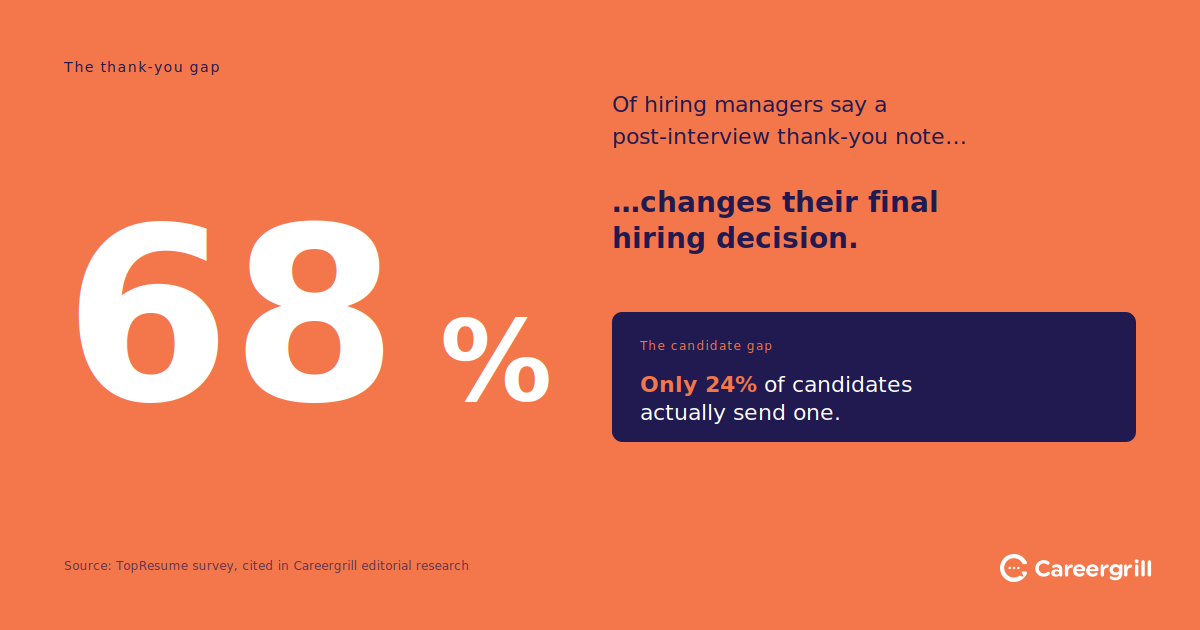
Send a thank-you email within 24 hours. This single action carries more weight than most Nigerian candidates realise. A TopResume survey found that 68% of hiring managers say thank-you notes impact their decision-making, and nearly one in five interviewers have dismissed candidates specifically because they didn't send one. Only 24% of candidates actually send them, which makes this a high-impact action taken by a small minority. Keep it short, three paragraphs maximum. Thank them for the conversation, reference one moment from the interview that resonated, and reaffirm your interest.
Do not pester. One thank-you email within 24 hours is professional. A second follow-up four or five days after the stated decision date is acceptable. Anything more damages your candidacy.
Do a quick self-debrief while the conversation is fresh. Write down what went well, what you'd do differently, and what questions caught you unprepared. That list is preparation material for your next interview.
Still getting interviews but not offers? If the 30 answers in this article got you thinking "I could tell a better story," that's the opening this book was written for. Why You Keep Getting Rejected After Interviews gives you the 14-day practice plan, the Story Bank worksheet, and the 6 frameworks to master behavioural interviews. Buy the book →
Frequently Asked Questions About Interview Questions and Answers in Nigeria
How long should my "Tell me about yourself" answer be in a Nigerian interview?
Your "Tell me about yourself" answer should run 60–90 seconds (roughly 150–200 spoken words). Use the Present-Past-Future formula: your current role, one or two relevant past experiences, and why this role is your next step. For recent graduates, lead with your NYSC placement and one skill it developed that maps to the role. Anything longer than two minutes signals poor self-editing.
What is the STAR method and how do I use it in interviews?
STAR stands for Situation, Task, Action, and Result: a four-part framework for answering behavioural interview questions. Situation sets the context in one to two sentences. Task names your specific responsibility. Action describes what you personally did, and it should carry the majority of your answer. Result quantifies the outcome. An upgraded version called STAR Enhanced adds Stakes, Specificity, and Numbers to make answers more extractable for Nigerian employers who want evidence-based answers.
What are the most common interview questions in Nigerian banks?
The most common questions in Nigerian bank interviews include "Tell me about yourself," "Why banking?", "What do you know about our bank?", and behavioural questions on customer service scenarios. Tier-1 banks also layer a computer-based aptitude test administered by Workforce Group or Dragnet Solutions before any human interview: numerical reasoning, verbal reasoning, and logical reasoning under tight time limits.
How do I answer "What are your salary expectations?" for a Nigerian job?
Give a salary range based on Nigerian market research, not a single figure. The most reliable sources are Jobberman's annual salary guide, Glassdoor Nigeria, and LinkedIn Salary. Express flexibility based on the overall package (HMO, pension, leave allowance, bonuses) rather than just base salary. Do not quote USD ranges for Nigeria-based roles unless the role is explicitly dollar-denominated.
Should I ask questions at the end of a Nigerian job interview?
Yes, always. Saying "No, I'm fine" signals weak preparation and low interest to Nigerian hiring managers, regardless of how polished the rest of the interview went. Walk in with at least five prepared questions. Two you can always ask: "What does success look like in the first ninety days?" and "What are the next steps in the process?"
What should I wear to a job interview in Nigeria?
Wear business formal attire for corporate interviews in Nigeria (suits for men, tailored suits or modest business dresses for women) unless the employer has specified otherwise. Banking, oil and gas, and Big Four consulting are strictly formal. Tech and fintech firms like Flutterwave and Paystack allow smart casual but avoid jeans for a first interview. Err on the side of slightly overdressed.
Want more Nigerian interview preparation content like this? Join Careergrill's weekly interview tips, delivered to your inbox every Tuesday. Sign up here →
Ready to Take the Next Step?
Explore our services to accelerate your journey.