How to Write a Professional Summary for a Nigerian CV (2026): Formula + Examples by Career Stage
Most Nigerian CVs waste their best space on a vague career objective. Here's how to write a professional summary that makes a recruiter keep reading.
A professional summary is the 3–4 line paragraph at the top of your CV that proves your value in numbers: your title, your experience level, one or two quantified strengths, and the role you're targeting. Nigerian recruiters also call it a personal statement, career summary, profile, or profile statement. Write a summary rather than an outdated career objective unless you're entry-level with no relevant experience to point to.
Get this section right and the rest of your CV gets read; get it wrong and the recruiter moves on before reaching your experience. Formal salaried roles are scarce in Nigeria with just 14.4% of employed Nigerians holding wage- or salary-paying jobs (National Bureau of Statistics Labour Force Survey, Q2 2024). So the few advertised positions draw heavy competition, and your summary decides whether you make the shortlist.
What is a professional summary on a Nigerian CV?
On a Nigerian CV, professional summary, personal statement, CV summary, career summary, profile summary, and profile statement all name the same section, so whichever term you searched, you're in the right place. Even a loosely-used career objective or objective statement points to the same block. Its job is to pitch you in three or four lines and frame everything the recruiter reads below it.
That position puts your summary first in the recruiter's line of sight, and recruiters spend an average of just 7.4 seconds on their first scan of a CV (Ladders' 2018 eye-tracking study). It is the most-read section on the page, and the one most likely to earn you a second look.
Professional summary vs career objective: which should you use?
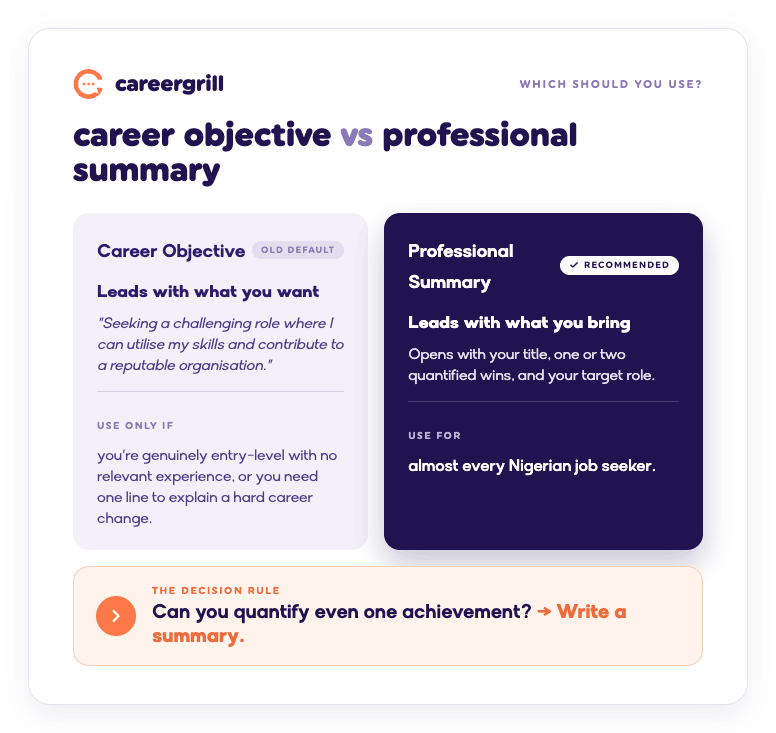
Use a professional summary. For almost every Nigerian job seeker in 2026, the career objective is the weaker choice. Resumeble's 2026 guide to Nigerian CV formats reaches the same conclusion: a short professional summary usually works better. A summary leads with what you already bring; an objective leads with what you want.
A generic objective such as "seeking a challenging role where I can utilise my skills and contribute to a reputable organisation" spends your most valuable space telling the recruiter something they already know, which is that you want the job. That space should be selling your strongest, most specific proof instead.
Keep the objective only in two cases. You're genuinely entry-level with no relevant experience to summarise, or you're making a hard career change and need one line to explain the pivot. Otherwise, write a summary. The one-line rule is that if you can quantify even a single achievement, you have enough for a summary.
How to write a professional summary in 4 steps
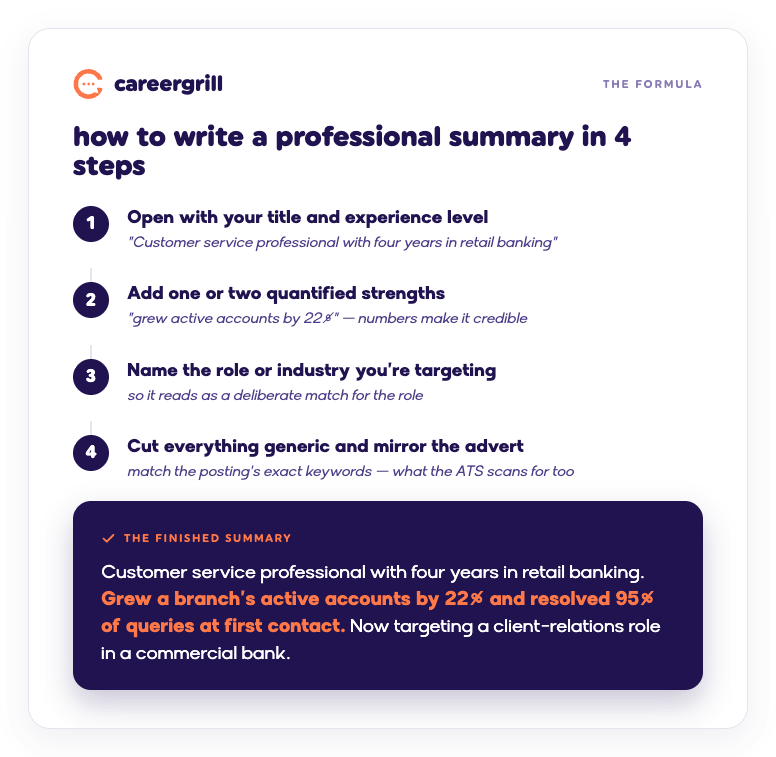
Write your summary last, so you can pull your strongest points into it. Keep it in the third person, with no "I", "me", or "my": write "Experienced accountant", not "I am an experienced accountant". Then build it in four steps:
- Open with your title and experience level: "Customer service professional with four years in retail banking".
- Add one or two quantified strengths. Numbers make it credible: "grew active accounts by 22%" beats "excellent at driving growth".
- Name the role or industry you're targeting, so it reads as a deliberate match for this role.
- Cut everything generic and mirror the advert: drop "hardworking team player" and match the exact keywords in the posting, which is what an ATS scans for too.
Together they produce something like: "Customer service professional with four years in retail banking. Grew a branch's active accounts by 22% and resolved 95% of queries at first contact. Now targeting a client-relations role in a commercial bank." Every element there earns its place: the title and numbers do the persuading, and the closing line signals you chose this role deliberately.
How do fresh graduates and NYSC members write a professional summary with no experience?
You've finished NYSC, you're applying to graduate programmes at MTN, Dangote, and GTBank, and the summary field stops you cold: what goes here when you have "no experience"? Start from what you have, because "no experience" is rarely true. Your final-year project, SIWES or internship placement, NYSC service, and any leadership role (course rep, fellowship, association exec) all count. Pull one result from those, lead with it, then name the field you're entering. A fresh-graduate summary should state your degree and class of honours, one or two strengths with proof, and your target role, in three to four lines.
Here's a summary we rewrote for a client, a recent NYSC completer moving from retail sales into administrative work:
BEFORE (a career objective, plus a personal-data block):
Objective: To develop excellent administrative skill through my degree in a direction where I could make a more significant contribution towards sustainable development of the organization.
(Followed by a "Personal Data" block listing date of birth, marital status, sex, state of origin, and religion.)
AFTER (a career-change professional summary):
Sales professional with 4+ years in competitive, multi-brand retail, now moving into administrative work and bringing the reliability, organisation, and communication that admin roles depend on. Sustained a monthly average of at least 70% of a sales target worth ₦10–15 million, regularly ran an outlet single-handedly, and reported activity and results to supervisors. Works independently, handles detail carefully, and stays steady under target pressure. Open to administrative roles across corporate and public-sector organisations.
The rewrite drops the vague objective and the personal-data block (date of birth, marital status, and religion don't belong on a modern Nigerian CV) and leads with a quantified result instead.
Professional summary examples for experienced professionals
An experienced professional's summary leads with proven track record. Where a graduate writes about potential, you write about what you've already delivered, in numbers. Open with your job title and years of experience, follow with two or three quantified wins, and name the level or sector you're targeting next.
Here's a summary we rewrote for a client, a programme manager in the development sector with around six years' experience:
BEFORE (buzzword-heavy, no numbers):
Impact-driven Development Professional with over six years of experience designing and delivering initiatives across AI for social good, innovation and technology, quality education, digital rights, and gender justice advocacy. Proven expertise in project and community management, community development, and innovation within non-profit and civil society contexts. A purpose-led leader with a strong track record in team leadership, stakeholder mobilization, and community-driven action, contributing meaningfully to the advancement of the Sustainable Development Goals. Recognised for creativity, operational excellence, and youth development leadership.
AFTER (specific and quantified):
Programme Manager working at the intersection of community-based gender-based-violence (GBV) programming and federal-and-foundation grant delivery. Built a GBV response system with a national human-rights body that resolved 10 of 12 reported cases within three months. Delivered a national AI-literacy competition drawing 1,400+ entries from all 36 states and the FCT. Manages a multi-currency donor portfolio across six international funders, with on-the-ground delivery across six states.
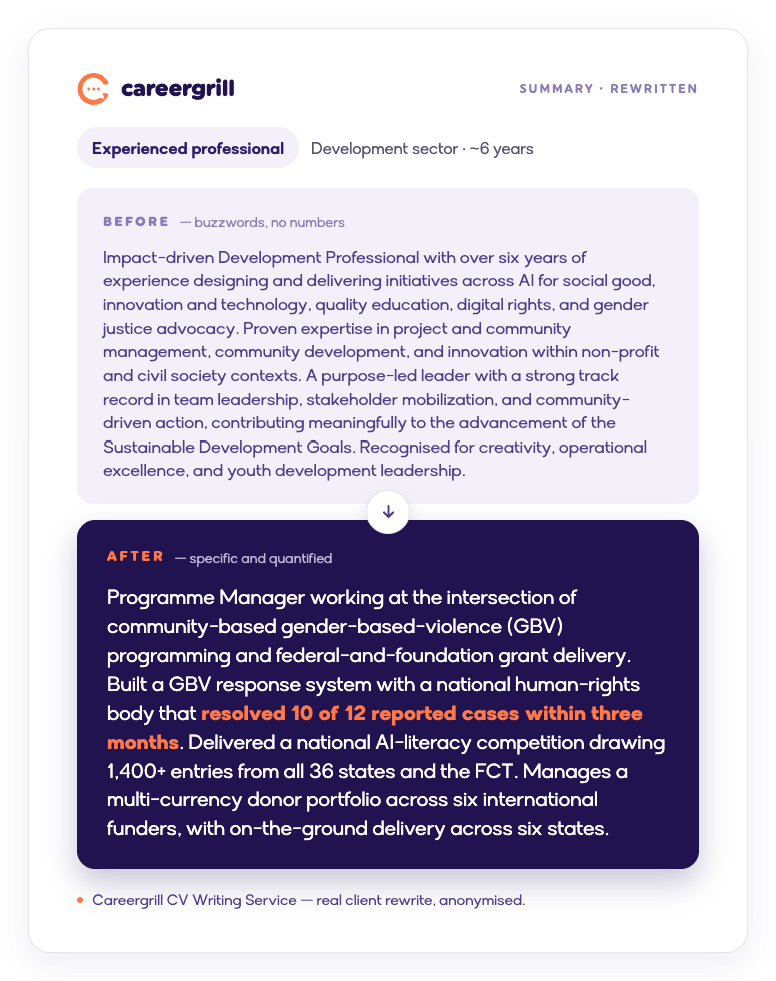
Every phrase in the AFTER version is something a recruiter can picture: 10 of 12 cases resolved, 1,400+ entries, six funders. The same principle works for a banking, tech, or marketing summary: swap in your own numbers and commit to one clear position rather than claiming five fields at once.
5 professional summary mistakes Nigerian job seekers make (and how to fix them)
Five errors recur in the summary section, each with a quick fix:
- Opening with a generic objective. "Seeking a challenging role to utilise my skills" says nothing. Fix: lead with your title and a proven result.
- Writing in the first person. "I am a hardworking and dedicated professional" reads as filler. Fix: drop "I/me/my" and go third person: "Financial analyst with five years in FMCG".
- Making claims with no numbers. "Excellent communicator with a proven track record" is unverifiable. Fix: attach a figure. One rewrite went from "proven ability to design and build scalable systems" to "saving institutions an estimated ₦3–4 million a year." Same career, now provable.
- Sending the same summary to every job. A recruiter can tell instantly. Fix: spend ten minutes matching it to each advert's keywords, which also helps you pass the ATS.
- Listing duties instead of value. "Responsible for managing accounts" describes the job, not your impact. Fix: show the result — "managed 15 accounts worth ₦200m at 98% retention".
These five stay strictly on the summary itself. For everything else that weakens a Nigerian CV, from formatting to photos, see the full list of CV mistakes to avoid.
Frequently Asked Questions About CV Professional Summaries
How long should a professional summary be on a Nigerian CV?
Keep it to three or four lines, about 50 to 80 words. A summary that runs longer stops being a summary and starts competing with your work-experience section. Recruiters scan the top of your CV in seconds, so a tight, specific paragraph earns more attention than a dense one.
Should a fresh graduate use a career objective or a professional summary?
Use a professional summary built from your projects, internship, and NYSC. Even with no paid experience, a summary that leads with a final-year project or an NYSC achievement beats a generic objective. Keep an objective only if you have genuinely nothing concrete to point to yet.
Do I write a professional summary in the first or third person?
Write it in the third person, with no "I", "me", or "my". Say "Marketing executive with three years in FMCG", not "I am a marketing executive". The third person reads as more professional and keeps the focus on your title and results rather than on the pronoun.
What's the difference between a personal statement and a professional summary?
There is no meaningful difference; in Nigeria they name the same section at the top of your CV. "Personal statement", "career summary", "profile", and "professional summary" are interchangeable labels for the 3–4 line pitch under your contact details. Pick one heading and keep it consistent.
Can I use the same professional summary for every job application?
No; tailor it to each role. A generic summary sent to every employer signals low effort and misses the keywords each advert uses. Spend ten minutes swapping in the target job title and two or three skills from the posting; this also improves how applicant tracking systems score your CV.
Prefer to skip the rewriting? Careergrill's CV Writing Service sharpens your professional summary and the rest of your CV for Nigerian employers, so you send out something built to clear both the ATS and the seven-second scan.
Ready to Take the Next Step?
Explore our services to accelerate your journey.