How to Write CV Bullet Points When Your Job Felt Boring: 4 Questions That Surface the Proof
The four diagnostic questions Careergrill uses to pull CV-worthy proof out of roles that look thin on paper with worked examples from our audit archive.
Most "boring" roles aren't boring — they're under-interrogated. Across past Careergrill CV Writing Service engagements, four questions consistently surface proof from roles that initially read thin: (1) what measurably changed during your tenure, (2) what people came to you for outside your job description, (3) what you did that no one told you to do, and (4) what broke when you weren't there. The proof is almost always there. Duty-based bullets hide it.
Why most Nigerian CVs read as boring (and why the role usually isn't the problem)
Open the average Nigerian CV and look at the bullets under the last role. Most of them describe what the role was rather than what changed because the person did it.
A back-office banker writes "Processed customer transactions and resolved complaints." A secondary school teacher writes "Taught English Language to junior secondary students." An NYSC corps member writes "Posted to Finance & Accounting unit; supported the team." Read together, these bullets could describe any banker, any teacher, any corps member. The role looks interchangeable, which makes the candidate look interchangeable.
The vocabulary comes from the job description the person was hired against, the appraisal form the employer used, and whichever previous CV they copied the formatting from. None of those documents was written to capture what actually happened during the tenure. The JD was written before the person showed up; the appraisal form was built to evaluate, not to describe.
Yale's Office of Career Strategy puts the principle simply: accomplishment statements describe impact and value, not just role and responsibilities (Yale OCS, Writing Impactful Resume Bullets).
Nigerian recruiters see the cost of this directly. "The most common pattern I see is how they always try to speak little of whatever they must have achieved in the past," says Esther Eleodimmo, an HR practitioner. "Not speaking with great confidence about your past achievements and accomplishments will only make you come off as though you're underselling yourself, which shouldn't be." Duty-based bullets are that underselling, rendered on the page: they describe the role's shape without ever claiming what the person did inside it.
Across past Careergrill CV Writing Service engagements, the duty-language pattern shows up in nearly every CV that arrives for a rewrite, including in the professional summary at the top, which fails for the same reason the bullets do. The role was interrogated once, when the person was hired, and never again. The four questions exist to do the second interrogation. For the wider frame this sits inside, see the complete CV guide for Nigerian professionals.
The 4-question framework, in the order they actually work
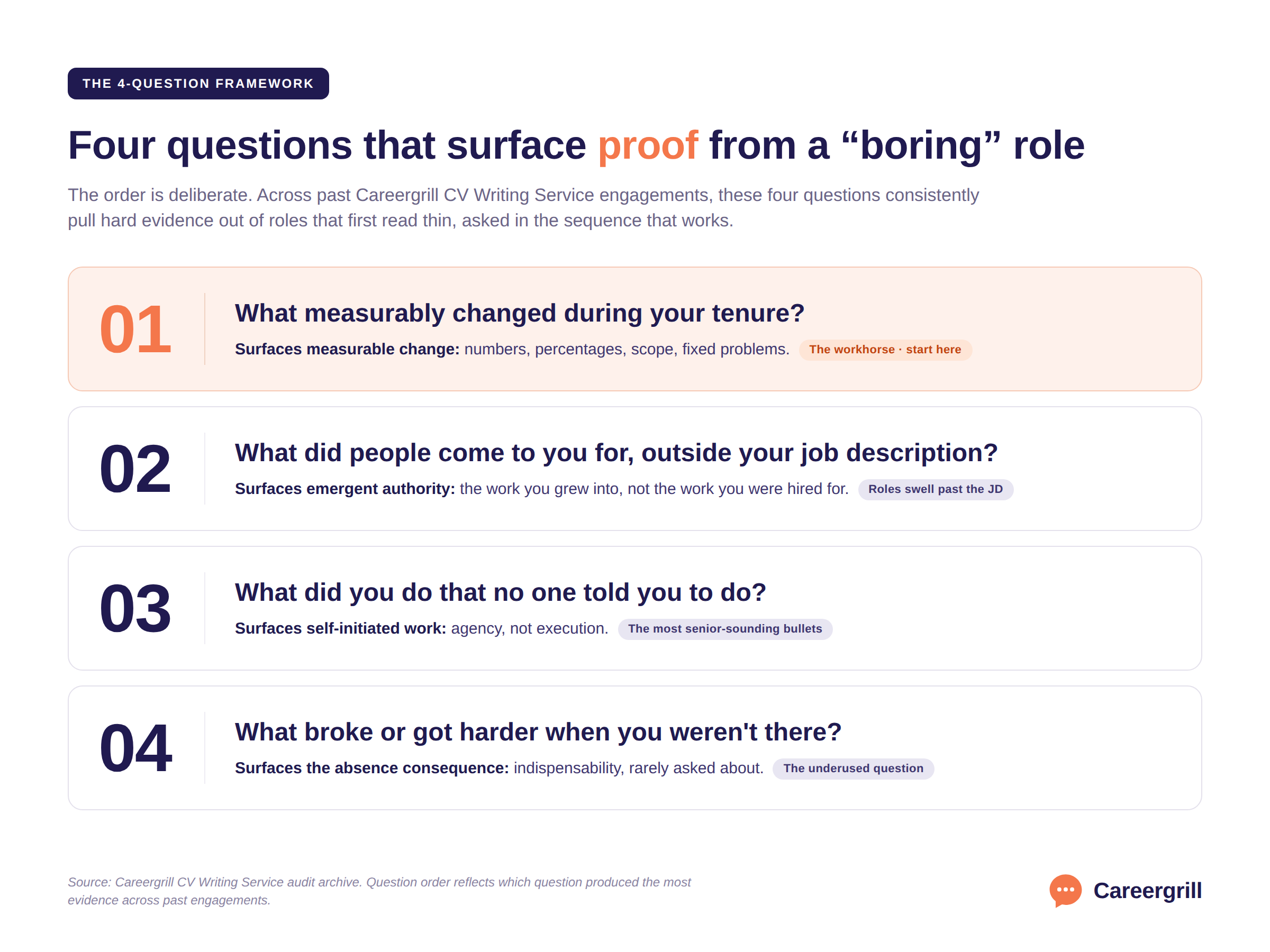
These are the four questions Careergrill uses across CV Writing Service engagements, in the order they work:
- What measurably changed during your tenure?
- What did people start coming to you for that wasn't in your job description?
- What did you do that no one told you to do?
- What broke or got harder when you weren't there?
The order matters. Across past Careergrill engagements, Question 1 produced the most evidence by a clear margin: measurable change is the easiest entry point, and most professionals can identify a number, a percentage, or a process improvement once asked directly. Question 2 surfaces emergent authority, which Nigerian roles tend to grow more than the JD admits. Question 3 produces the most senior-sounding bullets in the framework (self-initiated work signals seniority better than any title), so it sits late in the sequence. Question 4 is the underused one. In past discovery calls, "what fell apart when you weren't there?" was rarely asked by default, and the evidence sat unsurfaced because of it.
The four sections that follow walk through how each question opens a role.
Question 1: What measurably changed during your tenure?
This is the workhorse. Ask it of any role and you'll usually find a number, a percentage, a scope shift, or a process improvement that happened on your watch. The numbers don't have to be large; they have to be specific and traceable to your work.
What to ask yourself
Walk through these prompts for the role you're describing:
- Numbers that moved. Volumes, revenue, headcount, error rates, processing times, complaint volumes. If the role involved any kind of transaction or output, something was being counted somewhere.
- Processes that changed. A workflow that took five steps when you arrived and three when you left. A handover document that didn't exist before. A reconciliation routine you tightened.
- Scope that expanded. A territory you took on. A product line you added. A team that grew under you. A budget that increased.
- Problems that got fixed and stayed fixed. A backlog you cleared. A recurring complaint you resolved. A leak you traced.
If a prompt produces nothing on the first pass, hold the role and move to Question 2. Don't force evidence that isn't there.
How this looked in the audit archive
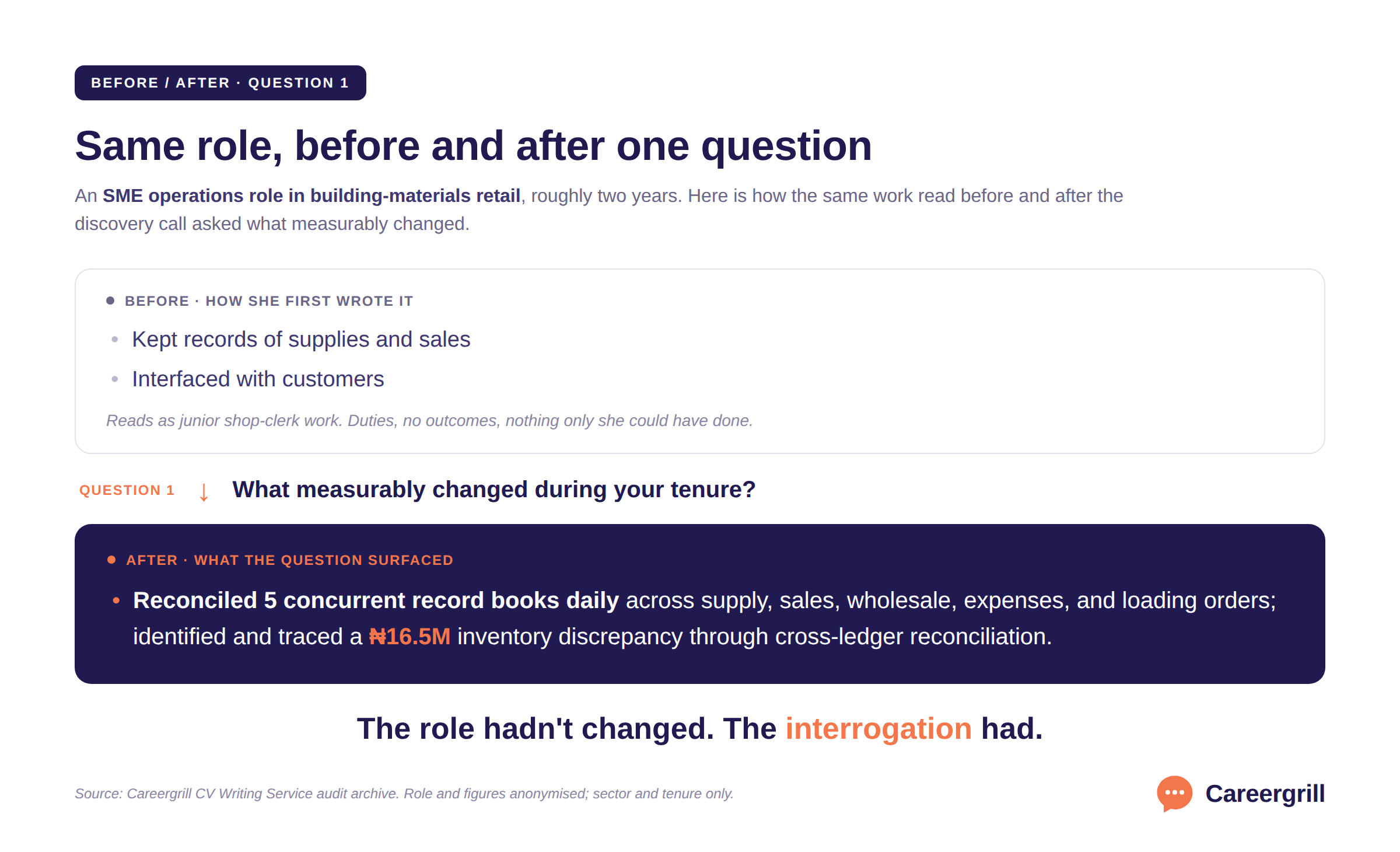
A Careergrill client who had run operations for an SME building materials retailer described her two-year role with bullets along the lines of "kept records of supplies and sales" and "interfaced with customers." The bullets read as junior shop-clerk work. The discovery call produced a different picture: she had been managing five concurrent record books daily (supply, sales, wholesale, expenses, and loading orders), reconciling all transactions into end-of-day summary reports submitted directly to the CEO. She coordinated monthly with external auditors for stock verification. During one reconciliation cycle, she identified and traced a ₦16.5M inventory discrepancy. The rewritten bullet captured the scope and the discrepancy. The role hadn't changed. The interrogation had.
The monetary figure is what makes that bullet count, especially in finance-adjacent roles. As Esther Eleodimmo puts it, applicants in the finance sector often fail to "clearly define how much, in monetary terms, you have added to a particular firm." A ₦16.5M discrepancy traced and resolved is exactly that definition.
Question 2: What did people start coming to you for that wasn't in your job description?
This question surfaces emergent authority: the work you grew into, not the work you were hired for. In Nigerian roles especially, the JD describes the entry point. The actual work usually swells past it within the first year, and the person doing it rarely gets a new title to match.
What to ask yourself
- Whose problems landed on your desk that weren't supposed to? A colleague's, a manager's, a department's, a client's.
- What were you the de facto person for? Drafting? Translating? Calming clients? Onboarding new hires? Fixing the spreadsheet nobody else understood?
- Who routed work to you that the org chart says should have gone elsewhere? Senior colleagues sending you their analysis to sanity-check. Clients calling your line directly because the official channel was slow.
- What new title would have fit, even informally? Many Nigerian professionals do a second job inside their first one without the org chart catching up.
If the answer is "nothing," the role was either short or strictly bounded. Move to Question 3.
How this looked in the audit archive
A graduate trainee on the data team of a Nigerian fintech platform described his first two years as "preparing dashboards" and "analysing customer data." The discovery call surfaced the trajectory underneath: his analyses had kept reaching the Head of Commerce, who eventually pulled him into a Commercial Analyst role outside the data team. There he co-designed a customer retention programme and a monetisation strategy that drove approximately 7% month-on-month revenue growth within three months of implementation. He had also been building dashboards for four distinct audiences (field agents, HR, department heads, the CEO) across roughly 5–10K customers and 200K+ monthly transactions. None of that trajectory was visible in the duty-based bullets he started with. The org chart hadn't caught up to him; the CV was reading from the org chart.
Question 3: What did you do that no one told you to do?
Self-initiated work is the strongest senior-signal evidence in the framework. The bullets that come out of this question survive any seniority bar because they describe agency, not just execution. Across past Careergrill CV Writing Service engagements, Question 3 produced the bullet a client most often described as "the one I wouldn't have known to write."
What to ask yourself
- Meetings you started attending without being assigned. Strategy sessions, cross-functional reviews, leadership check-ins where you weren't formally invited but became useful.
- Processes you fixed without being asked. A template you built. A shared folder you organised. A script you wrote. A handover document you produced because handovers were a mess.
- Projects you proposed and ran. A pilot you championed. A side initiative that became a programme. A pitch you made that got funded.
- People you trained, coached, or mentored without that being part of your role. Junior colleagues who came to you. Interns who stuck because of you.
These bullets are usually the strongest on the rewritten CV. Most professionals have at least one. Most never put it on the page.
How this looked in the audit archive
A senior surgical resident in paediatric surgery had described his three-plus years with general medical-officer-style bullets: no procedure types, no volumes, no protocols. He could have been any junior doctor anywhere. Question 3 produced two outputs from the same role. He had voluntarily coordinated the unit's cleft surgery programme (patient identification, pre-surgical optimisation, donor-agency documentation, follow-up), turning a disorganised process into a focal-person workflow. He had co-initiated a change in post-hypospadias wound-management protocol adopted unit-wide. During an industrial strike that disrupted blood supply, he led an audit that produced a hospital-wide protocol requiring lab certification of externally sourced blood before transfusion, still in standard practice today. One role. Three bullets. None on the original CV.
Question 4: What broke or got harder when you weren't there?
This is the underused question. In past Careergrill discovery calls, "what fell apart when you weren't there?" was rarely asked by default: most career conversations focus on what the person did, not what their absence cost. The evidence is usually there. The framing is what's missing.
The University of Arizona's career services office touches the same instinct in their bullet-writing guide: "If you're having a hard time coming up with a result, try to think of what would not have happened if you weren't there" (career.arizona.edu, APR Format). Arizona's guide stops short of naming it as a structured question; the four questions go further.
What to ask yourself
- What did the cover person struggle to replicate? Reports, client relationships, judgement calls, vendor negotiations, technical knowledge they didn't have.
- What did the backlog look like when you got back from leave? A messy inbox is a signal. A frozen project is louder.
- What handoffs failed when you transitioned out? What had to be redone, redocumented, or relearned.
- What only you knew? A workaround for a buggy system. A relationship with a difficult client. The history of a recurring complaint and how to defuse it.
Indispensability tells. The bullets it produces read as senior, regardless of the title.
How this looked in the audit archive
A Careergrill client had served his NYSC year at a state legislative house in the Finance & Accounting unit and had nearly left the role off his CV entirely. The original entry was two lines: "Posted to Finance & Accounting unit. Supported the team." The discovery call produced specifics. He had drafted four to five memos and letters weekly for the Director of Finance, including one to the State Governor returned with the comment "top-notch." On his own initiative he had begun sitting in on legislative council sessions outside his posting. Over time, members of the legislative side started consulting him on cost and budget questions during sessions because his notes were sharper than the assigned support staff. When he wasn't in the chamber, members had to rely on those staff. The absence consequence was the proof. The role he had nearly cut became one of the strongest entries on the rewritten CV.
From diagnosis to bullet: why the framework isn't enough on its own
The four questions surface what's there. Turning that evidence into CV-ready bullets is a separate craft.
From surfaced finding to finished bullet
A surfaced finding looks like this: "I identified and traced a ₦16.5M inventory discrepancy by reconciling five concurrent record books." A finished bullet looks like this: "Reconciled 5 concurrent record books daily across supply, sales, wholesale, expenses, and loading orders; identified and traced a ₦16.5M inventory discrepancy through cross-ledger reconciliation." Same content. The second one formats the bullets so the ATS can read them, survives the few seconds a recruiter spends on a first scan, and reads as senior.
The discovery call closes that gap. Across the audit archive, the strongest evidence on a rewritten CV was routinely something the client had never written down: work they'd done but never counted as achievement, because no one had ever asked them to. One Careergrill client who served his NYSC year at a state legislative house had nearly cut the role that became his strongest CV entry — the work was there; the framing wasn't. That pattern is the foundation the rewrite step works from.
Why polish alone can't reach the proof
What the rewrite does: a strong action verb, the project or context, the result with quantification, Nigerian employer format preferences, and the editing pass that earns the reader's attention before it drifts. Most Nigerian CV services start from the bullets the client already has and polish them. Polish cannot reach what isn't there. The framework solves the proof problem. The rewrite solves the bullet problem.
That distinction is the cleanest way to think about Careergrill's CV Writing Service. The audit produces the diagnosis. The rewrite produces the bullets. This diagnostic is the proof-surfacing layer of the complete CV guide for Nigerian professionals; the guide handles the rest.
Want the rewrite? The four questions surface the proof. Turning that proof into a CV that reads like the work you actually did takes another step: verb choice, ATS-readable formatting, sector-specific tailoring, and the editing pass that earns a recruiter's attention in the few seconds they spend on a first scan. That's what Careergrill's CV Writing Service does. Send us your current CV; we'll run the four questions on every role and rewrite the ones that need it.
Book a CV Writing Service consultation →
When the framework finds nothing (and what that actually means)
Sometimes the four questions produce nothing for a particular role. It happens. Two patterns explain most of those cases.
The first is depth. The questions need careful interrogation, not a mental scan. Sit with each one for the role. Talk it through with someone who knows the work. Most "nothing" findings on the first pass turn into something on the second.
The second is the role itself. Some roles are genuinely too short to accumulate proof: a three-month internship, a junior NYSC posting with minimal autonomy. Reframing won't change that. Let those roles take less space on the CV and shift the weight to the current role, project work, volunteer initiatives, or self-directed learning.
The audit archive skews toward roles with autonomy or tenure: that's where the richest evidence came from in past Careergrill CV Writing Service engagements. The framework works hardest where there's something to find.
Frequently Asked Questions About the 4-Question CV Framework
What if my role really was boring and nothing changed?
Most roles labelled "boring" produce evidence under interrogation, but not all. If you've worked through all four questions twice and nothing surfaces, the role was likely too short or too constrained for autonomy. The fix isn't framing — it's adding the current role's evidence sooner, or supplementing with project, volunteer, or self-directed work.
Should I list duties at all on my Nigerian CV?
A short context line for each role works fine; it tells the recruiter what the role was. The bullets underneath should be achievements, not duties. The Nigerian convention of listing 8–10 duty bullets per role is what makes most CVs read as interchangeable. Three to five achievement bullets per role outperform ten duty bullets every time.
How do I quantify achievements when I never tracked numbers?
Estimate honestly. If you handled customer complaints, estimate the daily volume. If you trained colleagues, count how many. If you reduced a process from days to hours, name the rough before-and-after. Use ranges if precise numbers aren't recoverable: "approximately," "around," "in the region of." Recruiters expect estimates for past roles.
Is this framework different from the STAR method?
Yes. STAR (Situation, Task, Action, Result) is a story structure for interview answers. The four questions are a diagnostic for surfacing CV-worthy evidence from a role you've already finished. Use the four questions to find the proof; use STAR to talk about that proof in the interview. Different stages, different tools.
Does this work for NYSC postings?
Yes, and the question most NYSC corps members under-ask is Question 4 (what broke when you weren't there?). The Careergrill audit archive includes a corps member whose initiative-driven work at a state legislative house produced multiple senior-signal bullets from a posting he had almost left off his CV entirely.
Will the four questions work for senior or executive roles?
Yes, they work harder for senior roles, where unrecorded work usually exists in more layers. Committees you sat on, decisions you unblocked, people you developed. Question 4 is especially productive at senior levels, where indispensability is often the strongest career proof you can put on a CV.
Ready to Take the Next Step?
Explore our services to accelerate your journey.